
Feeling Drained After Reiki Sessions? Here’s Why (And How to Prevent It).
Reiki Question: Why do I feel drained after giving Reiki?
A student asked me this recently, and I was so glad they did.
It is one of those questions that many practitioners quietly carry. There can be embarrassment around it. Or confusion. Sometimes even a little fear. “If Reiki is universal life force energy, why am I so tired after a session?”
We’ve all heard the beautiful descriptions of how Reiki is supposed to feel: a glowing, warm, peaceful experience that leaves you floating on a cloud of universal life force energy.
But what if, instead of feeling expansive and luminous, you feel tired… heavy… or strangely depleted?
Does that mean you did something wrong?
Does it mean you are not a strong enough channel?
Does it mean Reiki is taking something from you?
The short answer is no.
But I want to answer this thoughtfully, because there are a few important distinctions here.
So first, let us return to the foundations.
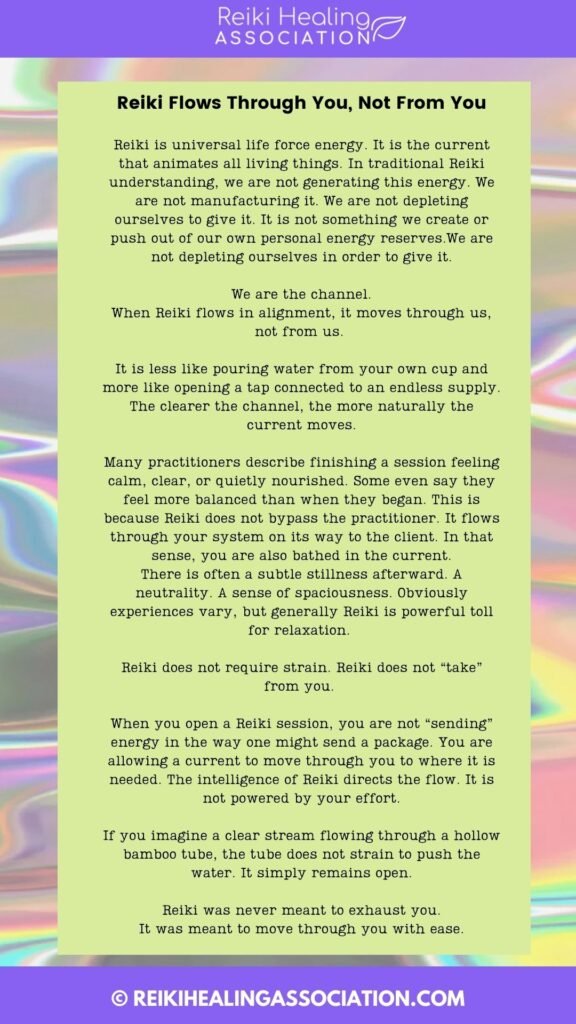
Reiki Flows Through You, Not From You
Reiki is universal life force energy. It is the current that animates all living things. In traditional Reiki understanding, we are not generating this energy. We are not manufacturing it. We are not depleting ourselves to give it. It is not something we create or push out of our own personal energy reserves.We are not depleting ourselves in order to give it.
We are the channel.
When Reiki flows in alignment, it moves through us, not from us.
It is less like pouring water from your own cup and more like opening a tap connected to an endless supply. The clearer the channel, the more naturally the current moves.
Many practitioners describe finishing a session feeling calm, clear, or quietly nourished. Some even say they feel more balanced than when they began. This is because Reiki does not bypass the practitioner. It flows through your system on its way to the client. In that sense, you are also bathed in the current.
There is often a subtle stillness afterward. A neutrality. A sense of spaciousness. Obviously experiences vary, but generally Reiki is powerful toll for relaxation.
Reiki does not require strain. Reiki does not “take” from you.
When you open a Reiki session, you are not “sending” energy in the way one might send a package. You are allowing a current to move through you to where it is needed. The intelligence of Reiki directs the flow. It is not powered by your effort.
If you imagine a clear stream flowing through a hollow bamboo tube, the tube does not strain to push the water. It simply remains open.
Reiki was never meant to exhaust you.
It was meant to move through you with ease.
So If You Feel Drained, What Is Happening?
If you feel incredibly drained or persistently fatigued when practising or receiving Reiki, it is not because Reiki is harming you or taking something from you.
More often, it is because something in your approach has subtly shifted.
Perhaps you are trying to fix rather than allow.
Perhaps you are attaching to outcome.
Perhaps you are leaning forward energetically, taking responsibility for the result.
Perhaps you are absorbing emotions rather than holding space.
Perhaps your own body simply needs more rest and nourishment.
Let’s be balanced here.
Occasional tiredness can happen. Especially if you are holding space for deep emotional release. Especially if you have had multiple sessions in one day. Especially if your own nervous system is already a little depleted.
We are human and some days we are naturally more tired and drained, and feeling occasionally tired after Reiki isn’t a failure or a red flag that I want you to panic about, but equally it also shouldn’t become your default experience every single time.
Sometimes what feels like “Reiki drain” is simply:
- You did not eat enough.
- You did not hydrate.
- You skipped grounding afterward.
- You held more emotional presence than you realised.
There is nothing mystical or dramatic about that. It is physiology.
The key difference is this:
Occasional tiredness is normal.
Consistent depletion is feedback.
If you regularly feel heavy, foggy, or energetically low after sessions, that is an invitation to refine your boundaries, your grounding techniques, and release any attachment to the outcome.
Let’s look deeper at some of the reasons you may be feeling drained, and how you can take some simple steps to prevent this energy drain.
The Reasons You Might Feel Drained
1. You arrived already running on empty.
Sometimes the session itself is flowing as it should, but you came in so depleted (poor sleep, chronic stress, skipped meals) that even a gentle, restorative experience can tip you into a rest your body has been quietly demanding for weeks. Reiki gives your body permission to finally stop and that can feel overwhelming if your tanks are already running low.
2. The “Healing Crisis”
When you receive Reiki, you are inviting your body to shift out of “fight or flight” and into “rest and digest.” During this deep state of relaxation, your body begins to clear out stagnant energy, emotional blockages, and physical tension.
- Detoxing takes energy: Just like your body feels tired when fighting off a cold, releasing deeply held emotional or energetic weight requires physical effort.
- The “unclenching” effect: If you’ve been holding onto stress for months or years, letting it go is exhausting. Imagine carrying a heavy backpack for ten miles and finally taking it off. You don’t immediately feel energized; your muscles feel heavy and tired because they can finally stop working so hard. We often call this the “healing crisis” or energetic detox. Reaction should be temporary so persistent issues after a Reiki session may indicate another issue that may require medical intervention.
3. You Might Be Using Your Own Energy Without Realising
This is the most common cause of post session fatigue.
When we care deeply about our clients, it is easy to slip into effort. We may try to push energy into a stubborn area. We may try to fix what feels broken. We may quietly assume responsibility for their healing outcome.
Underneath that can be thoughts like:
“I hope this works.”
“I need to help them.”
“I want them to feel better.”
All of those are human. All of those are understandable.
But in that moment, we stop allowing Reiki to do its work and begin giving from our personal reserves.
The shift can be almost imperceptible. Your shoulders tighten slightly. Your breath becomes shallower. There is a subtle leaning forward in your energy.
And afterward, you feel it.
Before your next session, try this simple internal statement:
“I am a clear channel for Reiki. The energy flows through me, not from me.”
Pause when you say it. Notice your body. Most practitioners feel an immediate softening. A sense of relief.
The more neutral and unattached you are to the outcome of a Reiki session, the more clearly Reiki flows.
If you ever feel yourself working hard during a session, that is your cue to step back energetically. Soften your breath. Relax your hands. Release the outcome.
This is something many practitioners learn through experience.
4. You May Be Absorbing Instead of Holding Space
Many Reiki practitioners are naturally empathic. That is often what drew you to this work in the first place.
But empathy without boundaries can cause issues. Without proper energetic hygiene, highly empathetic practitioners can inadvertently absorb the heavy, dense energy the client is releasing.
If you find yourself:
- Feeling your client’s emotions as if they are your own
- Thinking about their problems long after the session ends
- Carrying heaviness in your body afterward
The culprit is usually a well-meaning boundary issue.
Reiki does not ask you to suffer alongside someone in order to help them.
Grounding before and after sessions is essential. So is consciously releasing what is not yours. Even something as simple as washing your hands with the intention of clearing can be powerful.
You are there to hold the light, not to carry the weight. When your energy feels scattered, place one hand on your heart and one on your lower belly. Breathe. Call your energy back to yourself. Affirm:
“My energy returns to me now.”
“I release anything that is not mine.”
“I am clear. I am grounded. I am whole.”
Simple practices like this create powerful energetic hygiene over time.
Reiki practitioners are often generous by nature.
You may extend sessions. Add extra time. Offer additional emotional support. Skip breaks. Say yes when you are tired.
Over time, this erodes your reserves.
Healthy boundaries do not make you less compassionate. They make your work sustainable.
It is not selfish to protect your energy. It is responsible.
5. You May Need More Self-Reiki
This one is simple and often overlooked.
Are you giving more than you are receiving?
Regular self-treatment is not optional if you are practicing professionally. It stabilises your field. It strengthens your channel. It clears your own emotional build-up.
You cannot continuously give without replenishing.
Reiki flows more cleanly through a practitioner who is tending to their own healing.
6. Subtle Attachment to Outcome
Sometimes fatigue is not about energy at all. It is about pressure.
If part of you is measuring the session by whether the client felt something dramatic, whether pain reduced immediately, whether tears flowed, whether you “did enough,” your system is working harder than you realise.
Reiki does not require performance.
The intelligence of the energy moves where it is needed, in ways we cannot always see or measure in the moment. The more you release the need to witness visible results, the more relaxed your body becomes during the session.
Attachment creates tension. Tension uses energy.
Trust creates ease.
7. You Have Not Closed the Session Properly
Another practical consideration.
If you move straight from a Reiki session into emails, errands, or the next client without consciously closing the energetic space, your system can feel unfinished.
Take thirty seconds.
Thank Reiki.
Intentionally disconnect.
Brush down your aura.
Shake out your hands.
Step outside if possible.
Signal to your body that the session is complete.
Create your own closing rituals to end every session.

How to Prevent the Drain (And Bounce Back Faster)
The beautiful thing about this conversation is that once you understand why you might be feeling drained, you can make small adjustments that have a profound impact.
This is not about becoming rigid or overly ritualistic. It is about creating simple, supportive habits that protect your energy and strengthen your ability to channel Reiki.
Let’s look at what that can practically look like.
Ground Intentionally Before and After. If I could suggest one thing that makes the most consistent difference, it’s grounding – before, during, and after sessions. Grounding is not optional for practitioners. It is maintenance. Before the session: Feel your feet. Take three slow breaths. Visualise roots extending from your body into the earth. State your intention to be a clear channel. After the session: Shake out your hands. Brush down your aura. Step outside if possible. Consciously release the client’s energy. Do not skip the closing. Energetic hygiene is what makes this work sustainable.
Hydrate well before and after. I know this sounds almost too simple, but it genuinely helps. Water supports the physical body’s ability to process and flush out whatever is shifting. Don’t arrive parched, and don’t rush off without drinking something afterwards.
Give yourself transition time. One of the biggest mistakes people make is booking a reiki session and then rushing straight back to a full schedule…emails, meetings, school pick-ups. Even twenty minutes of quiet afterwards makes a noticeable difference. You’ve just asked your nervous system to soften. Let it.
Eat something grounding beforehand. Not a heavy meal, but something real — a piece of fruit, some nuts, a slice of toast. Being lightly nourished helps you stay anchored during the session rather than floating off in a way that can feel unmooring afterwards.
Communicate with your practitioner. If you are working with another practitioner, this is the most underrated tool available to you. Tell them if you’re going through a particularly intense period emotionally. Tell them if you’ve been unwell, or if the last session left you wiped out. A good practitioner will adjust their approach. You’re not being difficult by sharing this, you’re making the work more effective.
Rest, genuinely rest, that evening. Not just slumping in front of something on a screen, but real rest. A bath, an early night, gentle movement if that’s your thing. Your body is integrating. Let it.
Affirmations. Silently repeat: “Reiki flows through me effortlessly.” This helps interrupt the subtle belief that you are the one doing the work. It reminds your system to allow rather than push. Effort creates tension. Allowing creates flow.
Check in with how you feel the next day. For most people, if they felt tired after a session, they wake the following morning feeling notably clearer, lighter, or more settled. That’s the arc of healthy integration. If you feel worse or more depleted after two or three days, something else might be worth looking at, whether that’s a conversation with your practitioner, or speaking to your GP if something physical feels off.
Try this Exercise: The 3-Minute “Deep Root Drop”
1. Find your physical center Sit in a chair with your feet flat on the floor, or stand with your feet hip-width apart. Let your arms hang loosely at your sides or rest your hands palms-down on your thighs. Close your eyes and take three normal, unforced breaths just to notice where your body is in space.
2. The exhalation release Take a deep breath in through your nose. As you exhale heavily through your mouth (literally sigh it out), imagine a wave of heavy, static energy dropping from the top of your head, washing down your shoulders, down your spine, and pooling at the soles of your feet. Do this two more times. You are telling your body it is safe to put the energetic “backpack” down.
3. Visualize the roots Bring your awareness to the bottoms of your feet. Imagine thick, vibrant roots growing out of your soles, crashing right through the floorboards, through the foundation of the building, and plunging deep into the rich, dark soil of the earth. Send them down as far as you can—right to the stable, magnetic center of the planet.
4. Draw up the earth energy Now that you are anchored, change the flow of the visualization. With your next inhale, imagine drawing up cool, solid, nourishing earth energy through those roots. See it as a rich, calming color (like deep green, earthy brown, or warm gold). Pull it up through your feet, up your calves, into your knees, and let it settle right into your belly.
5. Seal the practice Rub your hands together briskly for a few seconds to create some physical friction and heat. Press your hands flat against your stomach (your solar plexus), take one last deep breath, and open your eyes. You are back in your body, back in the room, and back in your own energy.
To summarise:
Occasional tiredness can happen, especially after emotionally intense work. But consistent depletion is a signal, not a badge of honour.
If you are drained, do not push through it. Get curious.
Ask yourself:
- Did I try to fix something?
- Did I take responsibility for their healing?
- Did I merge emotionally?
- Did I skip my own grounding?
These are refinements, not mistakes.
If you’ve been feeling consistently drained and haven’t been sure what to do with that, I hope this gives you somewhere to start. Just remember: the more you release the need to do, fix, or carry, the lighter this work becomes.
If you have felt drained after Reiki, you are not alone. Most practitioners experience this at some stage in their journey.
It does not mean you are weak.
It does not mean you are failing.
It means you are learning.
And refinement is part of the path.
Got a question about your experience with reiki? Drop it in the comments below – I read everything and do my best to respond.
Have you Experienced Reiki Space Clearing Yet? Discover the SPIRAL Technique for Space Expansion.

© Copyright Reiki Healing Association™ 2026+ | All Worldwide Rights Reserved
Like this article? Share your thoughts in the comment box below!
And for more Reiki resources, be sure to connect with the Reiki Healing Association on Instagram, where we post daily Reiki inspiration and advice for healing and growth as a Reiki Practitioner or Reiki-enthusiast! And don’t forget to follow us on Pinterest, where we are pinning positive affirmations and empowering quotes every single day.
Have you read the latest issue of Universal Life Magazine yet? As Members of the RHA you get Exclusive Access to the Magazine, and to access your copy all you need to do is log in to your Member’s Area. You can get a copy of the magazine if you subscribe to our newsletter too!
More Articles For You
- RHA Launches World’s First Ho’oponopono Reiki Certification
- Issue 7 of RHA Universal Life Reiki Magazine Released – Read it here
- The Beautiful Cho-Ku-Rei: Power in the Palm of Your Hand
- How to Send Reiki to Wildlife
- How to Perform Distant Reiki with a Surrogate: A Step-by-Step Guide
- The Three Diamonds vs. Seven Chakras – what’s the difference?
- Just for today I will be Grateful – How to Live Each Day with Gratitude
- Setting Up Your Week For Powerful Reiki Sessions
- What to Expect during a Reiki Session: Our Members Share the most common experiences
